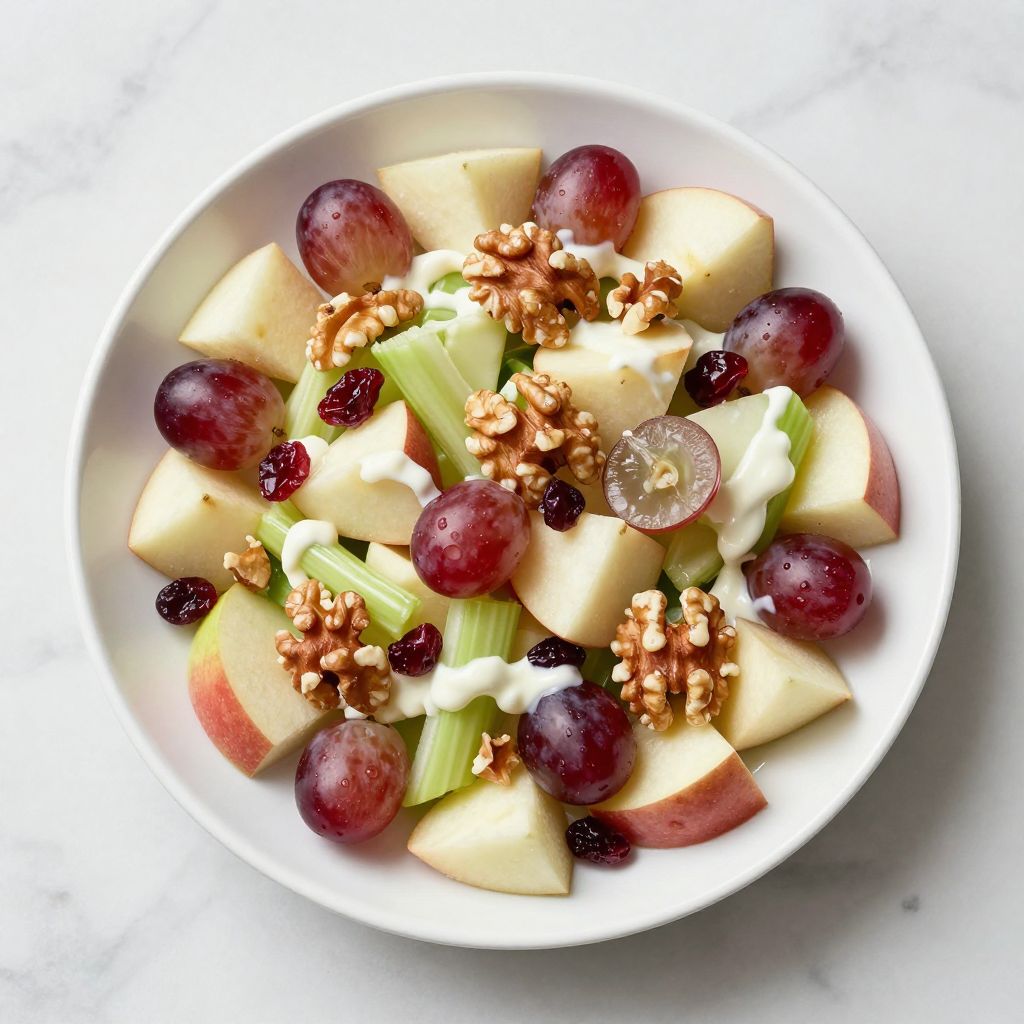
Waldorf salad brings together crisp apples, crunchy walnuts, and tender celery in a creamy dressing that has earned its place at tables for over a century. This classic American salad works equally well as a refreshing side dish or a light lunch that comes together in under fifteen minutes.
What makes this version stand out is the balance. Every bite delivers sweetness, crunch, and tang in equal measure, and the dressing coats without drowning.
What Makes This Recipe Worth Your Time
This Waldorf salad recipe respects the original while fixing the common mistakes that turn a legendary dish into a soggy afterthought. You get a salad that holds up on a buffet table and tastes even better the next day.
- Ready in 15 minutes with no cooking required, making it perfect for busy weeknights or last minute entertaining.
- Naturally gluten free as written, so it works for mixed dietary needs without any modifications.
- Budget friendly elegance that costs a fraction of restaurant versions while tasting significantly better.
- Make ahead friendly components let you prep everything in advance and toss together right before serving.
- Kid approved crunch that gets children eating apples, celery, and grapes without complaint.
A Little Background on This Dish
The Waldorf salad was born in 1893 at the Waldorf Hotel in New York City, created by maître d’hôtel Oscar Tschirky. The original version contained only apples, celery, and mayonnaise, with walnuts added to the recipe a few years later.
What started as an elegant hotel dish quickly became an American classic that spread across the country. The combination of fruit, nuts, and creamy dressing influenced countless other salads and remains a fixture at holiday tables, church potlucks, and upscale brunches alike.
My Experience With This Recipe
I started making Waldorf salad because my kids refused to eat raw celery in any other form. Something about the combination of sweet apples and creamy dressing changed their minds completely.
My early attempts were disasters of the watery variety. I kept wondering why the salad looked great when I made it but turned into a puddle by the time we sat down to eat, until I figured out the apple prep was the problem.
The first time I got the proportions right, my youngest asked for seconds of a salad, which had never happened before. The crunch of the walnuts against the soft grapes, the bright acidity cutting through the richness, it all came together in a way that finally felt like the salads I remembered from my grandmother’s kitchen.
Before You Start: Key Things to Know
This salad suits complete beginners and takes almost no active effort. The only real challenge is keeping the apples from browning before you finish assembling.
- Difficulty level: Easy, suitable for first time cooks with basic knife skills.
- Active time versus passive time: All 15 minutes are active with no waiting periods.
- Most important equipment: A sharp knife for clean apple and celery cuts that hold their texture.
- Step requiring most attention: Cutting the apples last and coating them in lemon juice immediately to prevent browning.
Recipe at a Glance
- Recipe Name: Classic Waldorf Salad
- Yield: 6 servings
- Prep Time: 15 minutes
- Cook Time: 0 minutes
- Total Time: 15 minutes
- Difficulty: Easy
- Course: Salad, Side Dish
- Cuisine: American
- Calories per Serving: 285
How to Source the Best Ingredients
Waldorf salad has so few ingredients that each one must pull its weight. Subpar apples or stale walnuts will sink the entire dish.
- Apples: Choose firm, crisp varieties like Honeycrisp, Fuji, or Granny Smith with tight skin and no soft spots. Press gently near the stem; it should not give at all.
- Celery: Look for pale green stalks that snap cleanly when bent, with fresh leaves that show no yellowing or wilting.
- Walnuts: Buy from a store with high turnover and smell before using. Rancid walnuts smell like paint and will ruin the salad.
- Grapes: Select firm red or green grapes still attached to green, flexible stems. Avoid any with wrinkled skin or brown stem ends.
- Mayonnaise: Use full fat mayonnaise from a freshly opened jar for the best emulsion and flavor.
Ingredients for Waldorf Salad
For the Salad
- 3 medium apples, cored and cut into half inch cubes (about 3 cups)
- 1 tablespoon fresh lemon juice
- 1 and a half cups celery, sliced into quarter inch pieces (about 3 stalks)
- 1 cup red seedless grapes, halved
- 1 cup walnuts, roughly chopped and toasted
- Half cup dried cranberries (optional)
For the Dressing
- Half cup mayonnaise
- Quarter cup sour cream or Greek yogurt
- 1 tablespoon honey
- 1 teaspoon Dijon mustard
- Quarter teaspoon salt
- Pinch of white pepper
Smart Substitutions and Swaps
- Mayonnaise: Provides the creamy base and emulsification that binds the salad. Substitute with plain Greek yogurt for a lighter version, but expect a tangier flavor and slightly thinner coating.
- Walnuts: Add the signature earthy crunch and healthy fats. Pecans work as a sweeter substitute, or use toasted almonds for a milder flavor with similar texture.
- Apples: Provide sweetness and the primary crunch factor. Asian pears offer similar texture with more floral notes, though they brown faster.
- Celery: Contributes a fresh, vegetal crunch and subtle bitterness. Fennel bulb, thinly sliced, adds an anise note but maintains the crisp texture.
- Grapes: Balance the salad with juicy sweetness. Pomegranate seeds work in fall and winter, or use fresh blueberries in summer.
- Sour cream: Adds tang and loosens the dressing consistency. Crème fraîche gives a more subtle tang, or skip it entirely and use all mayonnaise for a richer result.
- Honey: Rounds out the dressing with gentle sweetness. Maple syrup adds a deeper flavor profile, or use agave for a neutral sweetness.
Tools and Equipment You Will Need
Having everything ready before you start means your apples spend less time exposed to air. Mise en place matters even for a simple salad.
- Sharp chef’s knife (clean cuts prevent bruising and keep ingredients crisp)
- Cutting board
- Large mixing bowl
- Small mixing bowl for dressing
- Whisk or fork
- Measuring cups and spoons
- Small skillet for toasting walnuts (brings out their oil and deepens flavor)
- Citrus juicer or reamer
- Rubber spatula
How to Make Waldorf Salad
Read through all steps before starting and have your lemon juice ready before you cut the apples. The apples should be the last ingredient you prep to minimize browning time.
Step 1: Toast the Walnuts
Place the roughly chopped walnuts in a dry skillet over medium heat. Shake the pan every 30 seconds to prevent burning and toast for 3 to 4 minutes total.
Toasting activates the oils in the walnuts and creates a deeper, more complex flavor that raw walnuts cannot match. This single step transforms the salad from ordinary to memorable.
Watch for the walnuts to turn golden brown and release a warm, nutty aroma. Remove them immediately when you smell that fragrance because they will continue cooking from residual heat.
Step 2: Prepare the Lemon Juice
Juice the lemon into a large mixing bowl, removing any seeds. You need one full tablespoon of fresh juice.
The acid in lemon juice prevents enzymatic browning by lowering the pH on the apple surface. This reaction happens within minutes of cutting, so having the juice ready is critical.
Step 3: Wash and Dry the Celery
Rinse the celery stalks under cold water and dry them thoroughly with paper towels or a clean kitchen towel. Remove any leaves and trim the ends.
Excess water on the celery will dilute your dressing and make the salad watery. Taking thirty seconds to dry properly prevents this common problem.
The celery should squeak slightly when you rub it, indicating it is completely dry and ready to slice.
Step 4: Slice the Celery
Cut the celery stalks crosswise into quarter inch slices, keeping them uniform for consistent texture. You should have about one and a half cups.
Uniform pieces ensure every bite contains the same ratio of ingredients. Uneven chunks create bites that are all celery or no celery, which throws off the balance.
Step 5: Halve the Grapes
Cut each grape in half lengthwise through the stem end. Place the halves in a separate bowl.
Whole grapes roll around the plate and are difficult to eat with a fork. Halving them also exposes more surface area to the dressing, integrating their sweetness throughout.
The cut surface should look juicy and the grape should feel firm. Soft or mealy grapes will not hold up in the salad.
Step 6: Prepare the Apples
Core the apples and cut them into half inch cubes, leaving the skin on for color and texture. Work quickly and add the cubes directly to the bowl with lemon juice as you cut.
Apple skin contains most of the fiber and adds visual appeal with its red or green color. The skin also helps the cubes hold their shape in the dressing.
Toss the apple cubes gently in the lemon juice until every piece is coated. They should glisten slightly, which tells you the acid barrier is in place.
Step 7: Make the Dressing
In a small bowl, whisk together the mayonnaise, sour cream, honey, Dijon mustard, salt, and white pepper until completely smooth. Taste and adjust seasoning.
The combination of mayonnaise and sour cream creates a dressing that is rich but not heavy. The sour cream adds tang that brightens the overall flavor and prevents the salad from tasting flat.
The dressing should fall off the whisk in a thick ribbon and hold its shape for a moment before settling. If it seems too thick, add a teaspoon of lemon juice to thin it.
Step 8: Combine the Salad Base
Add the celery and halved grapes to the bowl with the apples. If using dried cranberries, add them now. Toss gently to distribute.
Combining the base ingredients before adding the dressing ensures even distribution. If you add dressing first, the ingredients tend to clump together.
Step 9: Add the Dressing
Pour the dressing over the salad base and fold gently with a rubber spatula until every piece is lightly coated. Avoid stirring vigorously.
Aggressive mixing breaks down the apple cubes and crushes the grapes, releasing liquid that dilutes the dressing. A gentle folding motion coats without damaging.
Each piece should have a thin, glossy coating of dressing. You should still see the individual colors of each ingredient through the light coating.
Step 10: Add the Toasted Walnuts
Fold in most of the toasted walnuts, reserving about two tablespoons for garnish. Distribute them evenly throughout the salad.
Adding nuts at the end preserves their crunch. Nuts added too early absorb moisture from the dressing and turn soft.
Step 11: Season and Adjust
Taste the salad and adjust the seasoning. Add more salt, lemon juice, or honey as needed to balance the flavors.
Every batch of apples and grapes has different sugar levels, so tasting and adjusting is not optional. A salad that tastes flat usually needs a pinch more salt or a squeeze of lemon.
The flavor should hit sweet first, then tangy, with a subtle savory finish from the celery. If any element dominates, adjust accordingly.
Step 12: Garnish and Serve
Transfer the salad to a serving bowl and top with the reserved walnuts. Serve immediately or refrigerate for up to one hour to let flavors meld.
The reserved walnuts on top provide textural contrast and visual appeal. They also signal to guests what flavors to expect before the first bite.
The surface should look fresh and inviting with visible pieces of each ingredient. If the salad looks muddy or homogeneous, you have overdressed or overmixed.
Pro Tip: For the crunchiest salad, keep the dressed base and walnuts separate until the moment of serving. Toss them together tableside for maximum texture contrast.
The Science Behind the Technique
The lemon juice treatment works through a process called acidulation. Apples brown when an enzyme called polyphenol oxidase reacts with oxygen, but this enzyme becomes inactive in acidic environments below pH 4.
The combination of mayonnaise and sour cream creates a stable emulsion that clings to ingredients without sliding off. Mayonnaise already contains emulsifiers from egg yolk, and adding sour cream increases the water content slightly while maintaining the coating ability.
Chef Note: Toasting walnuts before adding them releases volatile compounds that make them taste three times as nutty as raw walnuts, a transformation that takes just four minutes but makes a dramatic difference.
Tips for Getting It Right Every Time
- Cut apples last and work quickly to minimize browning, even with the lemon juice treatment.
- Use room temperature dressing ingredients for the smoothest emulsion and easiest mixing.
- Toast nuts in small batches to ensure even browning and prevent burning.
- Dry all ingredients thoroughly before mixing to prevent a watery salad.
- Taste before serving and trust your palate to guide final seasoning adjustments.
- Chill serving bowls for 15 minutes before plating to keep the salad cool and crisp longer.
Mistakes That Will Ruin Your Dish
- Cutting apples first gives them too much time to oxidize and turn brown, making the salad look unappetizing and taste slightly off.
- Skipping the walnut toasting leaves you with bland, slightly bitter nuts that add nothing to the overall flavor profile.
- Overdressing the salad drowns the fresh ingredients and creates a heavy, mayonnaise forward dish instead of a bright, balanced one.
- Using wet ingredients introduces extra liquid that breaks down the dressing and leaves a puddle at the bottom of the bowl.
- Mixing too aggressively crushes the grapes and bruises the apples, releasing juice that dilutes everything and destroys the texture.
Make Ahead and Meal Prep Tips
This salad works well for meal prep when you store components separately and assemble fresh. The dressing actually improves after a day in the refrigerator as flavors meld.
- Dressing: Make up to 5 days ahead, store in an airtight container, and whisk before using.
- Celery and grapes: Prep up to 2 days ahead, store in separate airtight containers with a paper towel to absorb moisture.
- Toasted walnuts: Toast up to 1 week ahead, store in an airtight container at room temperature, away from heat and light.
- Apples: Cut no more than 2 hours before serving, tossed in lemon juice and stored in an airtight container in the refrigerator.
What to Serve With Waldorf Salad
Waldorf salad shines as part of a larger spread at holiday meals, brunch buffets, or casual dinner parties. It pairs best with proteins that echo its sweet and savory balance.
- Roast chicken: The crisp skin and savory meat complement the creamy, fruity salad perfectly.
- Grilled pork chops: Pork’s natural sweetness harmonizes with the apples and grapes.
- Turkey sandwiches: A classic combination that works for lunch or light dinner.
- Baked ham: The salty, smoky meat balances the salad’s sweetness beautifully.
- Crusty bread: A simple baguette provides textural contrast and helps scoop up extra dressing.
Drink Pairings
A crisp white wine with good acidity mirrors the apple notes in the salad while cutting through the creamy dressing. Riesling, especially a dry or off dry German version, is my go to pairing.
- Wine: Dry Riesling or unoaked Chardonnay, both offering apple notes and bright acidity.
- Beer: German wheat beer or Belgian witbier, with citrus notes that complement the lemon in the dressing.
- Non alcoholic: Sparkling apple cider or a tart lemonade, echoing the salad’s fruit flavors.
- Hot drink: Chamomile tea with honey provides a soothing counterpoint for cooler weather meals.
Flavour Variations Worth Trying
- Autumn harvest: Replace grapes with diced pear and add dried cherries. The result is deeper and more seasonally appropriate for fall tables.
- Tropical twist: Substitute mango for half the apples and use macadamia nuts instead of walnuts. The flavor becomes brighter and more exotic.
- Savory shift: Add crumbled blue cheese and replace honey with a touch more mustard. The salad becomes more complex and dinner party appropriate.
- Protein packed: Fold in cubed rotisserie chicken and serve over butter lettuce. This transforms the side dish into a complete meal.
- Curry spiced: Add half a teaspoon of curry powder to the dressing and use golden raisins instead of grapes. The warmth adds unexpected depth.
How to Adapt This Recipe for Your Diet
- Gluten free: This recipe is naturally gluten free as written. Verify that your Dijon mustard brand does not contain wheat based additives.
- Dairy free: Replace sour cream with additional mayonnaise or use a coconut cream based alternative. The texture remains similar with slightly different flavor.
- Vegan: Use vegan mayonnaise and replace honey with maple syrup. The result is lighter but equally satisfying.
- Low carb: Omit the grapes and dried cranberries, double the celery, and use only green apples. Net carbs drop significantly while maintaining the classic profile.
- High protein: Add half a cup of cubed grilled chicken breast and use Greek yogurt in place of sour cream. Protein per serving increases to over 15 grams.
How to Store and Reheat
In the Refrigerator
Store leftover Waldorf salad in an airtight glass or plastic container for up to 3 days. Place a piece of plastic wrap directly on the surface to minimize air exposure.
- Stir gently before serving to redistribute dressing that has settled.
- Add a few fresh walnut pieces on top to restore crunch to day old salad.
In the Freezer
Waldorf salad does not freeze well because the high water content in the fruit and vegetables breaks down during thawing. The texture becomes unpleasantly soft and watery.
- Freeze only the toasted walnuts if you have made extra, for up to 3 months.
- The dressing can be frozen separately for up to 1 month, though it may need rewhisking after thawing.
Reheating
This salad is served cold and should not be heated. Bring refrigerated salad to cool room temperature for 10 minutes before serving for best flavor.
- From refrigerator: Remove 10 minutes before serving and stir gently to refresh.
- Texture restoration: Add a tablespoon of fresh dressing and new walnuts to revive day old salad.
- Avoid: Never microwave or heat this salad, as the mayonnaise will break and the fruit will become mushy.
Cost Breakdown
Making Waldorf salad at home costs a fraction of restaurant or deli versions while tasting significantly fresher. A batch serving six costs less than a single prepared salad from most grocery stores.
| Ingredient | Estimated Cost |
|---|---|
| Apples (3 medium) | $2.25 |
| Celery (3 stalks) | $0.75 |
| Red grapes (1 cup) | $1.50 |
| Walnuts (1 cup) | $2.50 |
| Mayonnaise | $0.50 |
| Sour cream | $0.40 |
| Lemon, honey, seasonings | $0.60 |
| Total Per Serving | $1.42 |
Nutrition Information
| Nutrient | Amount |
|---|---|
| Calories | 285 |
| Total Fat | 21g |
| Saturated Fat | 3g |
| Trans Fat | 0g |
| Cholesterol | 10mg |
| Sodium | 180mg |
| Total Carbohydrates | 22g |
| Dietary Fiber | 3g |
| Total Sugars | 17g |
| Added Sugars | 3g |
| Protein | 4g |
| Vitamin D | 0mcg |
| Calcium | 35mg |
| Iron | 1mg |
| Potassium | 220mg |
Nutritional values are estimates based on standard ingredients and may vary depending on specific brands, apple varieties, and portion sizes used.
Frequently Asked Questions
Can I use a different type of nut instead of walnuts?
Pecans are the best substitute, offering similar texture with a sweeter flavor. Toasted almonds or cashews work but change the character of the dish.
Can I make Waldorf salad the night before?
Yes, but store the dressing, walnuts, and salad base separately. Combine everything no more than two hours before serving for the best texture.
How long does Waldorf salad last in the refrigerator?
Properly stored in an airtight container, the salad keeps for up to 3 days. The apples will soften slightly but the flavor remains good.
Why is my Waldorf salad watery?
Wet ingredients or overdressing are the usual culprits. Dry all produce thoroughly and use just enough dressing to lightly coat each piece.
Can I double this recipe for a crowd?
Yes, the recipe doubles easily. Use two separate bowls for mixing to avoid crushing ingredients, then combine gently before serving.
Should I peel the apples for Waldorf salad?
Leaving the skin on is traditional and adds color, fiber, and texture. Peel only if you strongly prefer a smoother bite.
Can I add chicken to make this a main dish?
Absolutely. Add 2 cups of cubed rotisserie or grilled chicken to transform this into a satisfying lunch or light dinner for four.
My Final Word
A well made Waldorf salad proves that simple ingredients handled with care produce dishes that have lasted for over a century. The crunch of fresh apples, the warmth of toasted walnuts, and the bright tang of the dressing create something greater than the sum of its parts.
I have made this salad dozens of times over the years, tweaking and testing until every element earns its place. Give it a try this week, and do not be afraid to adjust the proportions to suit your own taste.
If you make this recipe, I would love to hear how it turned out. Drop a comment below or tag us on social media with your version.
Classic Waldorf Salad
Waldorf salad brings together crisp apples, crunchy walnuts, and tender celery in a creamy dressing. This classic American salad works equally well as a refreshing side dish or a light lunch that comes together in under fifteen minutes.
- Sharp chef’s knife
- Cutting board
- Large mixing bowl
- Small mixing bowl
- Whisk or fork
- Measuring cups and spoons
- Small skillet
- Citrus juicer or reamer
- Rubber spatula
For the Salad
- 3 medium apples (cored and cut into half inch cubes (about 3 cups))
- 1 tablespoon fresh lemon juice
- 1 and a half cups celery (sliced into quarter inch pieces (about 3 stalks))
- 1 cup red seedless grapes (halved)
- 1 cup walnuts (roughly chopped and toasted)
- Half cup dried cranberries (optional)
For the Dressing
- Half cup mayonnaise
- Quarter cup sour cream or Greek yogurt
- 1 tablespoon honey
- 1 teaspoon Dijon mustard
- Quarter teaspoon salt
- Pinch of white pepper
- Place the roughly chopped walnuts in a dry skillet over medium heat. Shake the pan every 30 seconds to prevent burning and toast for 3 to 4 minutes total until golden brown and fragrant. Remove immediately and set aside to cool.
- Juice the lemon into a large mixing bowl, removing any seeds. You need one full tablespoon of fresh juice.
- Rinse the celery stalks under cold water and dry them thoroughly with paper towels. Remove any leaves and trim the ends.
- Cut the celery stalks crosswise into quarter inch slices, keeping them uniform. You should have about one and a half cups.
- Cut each grape in half lengthwise through the stem end. Place the halves in a separate bowl.
- Core the apples and cut them into half inch cubes, leaving the skin on. Work quickly and add the cubes directly to the bowl with lemon juice as you cut. Toss gently until every piece is coated.
- In a small bowl, whisk together the mayonnaise, sour cream, honey, Dijon mustard, salt, and white pepper until completely smooth. Taste and adjust seasoning.
- Add the celery and halved grapes to the bowl with the apples. If using dried cranberries, add them now. Toss gently to distribute.
- Pour the dressing over the salad base and fold gently with a rubber spatula until every piece is lightly coated. Avoid stirring vigorously.
- Fold in most of the toasted walnuts, reserving about two tablespoons for garnish. Distribute them evenly throughout the salad.
- Taste the salad and adjust the seasoning. Add more salt, lemon juice, or honey as needed to balance the flavors.
- Transfer the salad to a serving bowl and top with the reserved walnuts. Serve immediately or refrigerate for up to one hour to let flavors meld.
For the crunchiest salad, keep the dressed base and walnuts separate until the moment of serving. Store leftover salad in an airtight container for up to 3 days. The dressing can be made up to 5 days ahead.