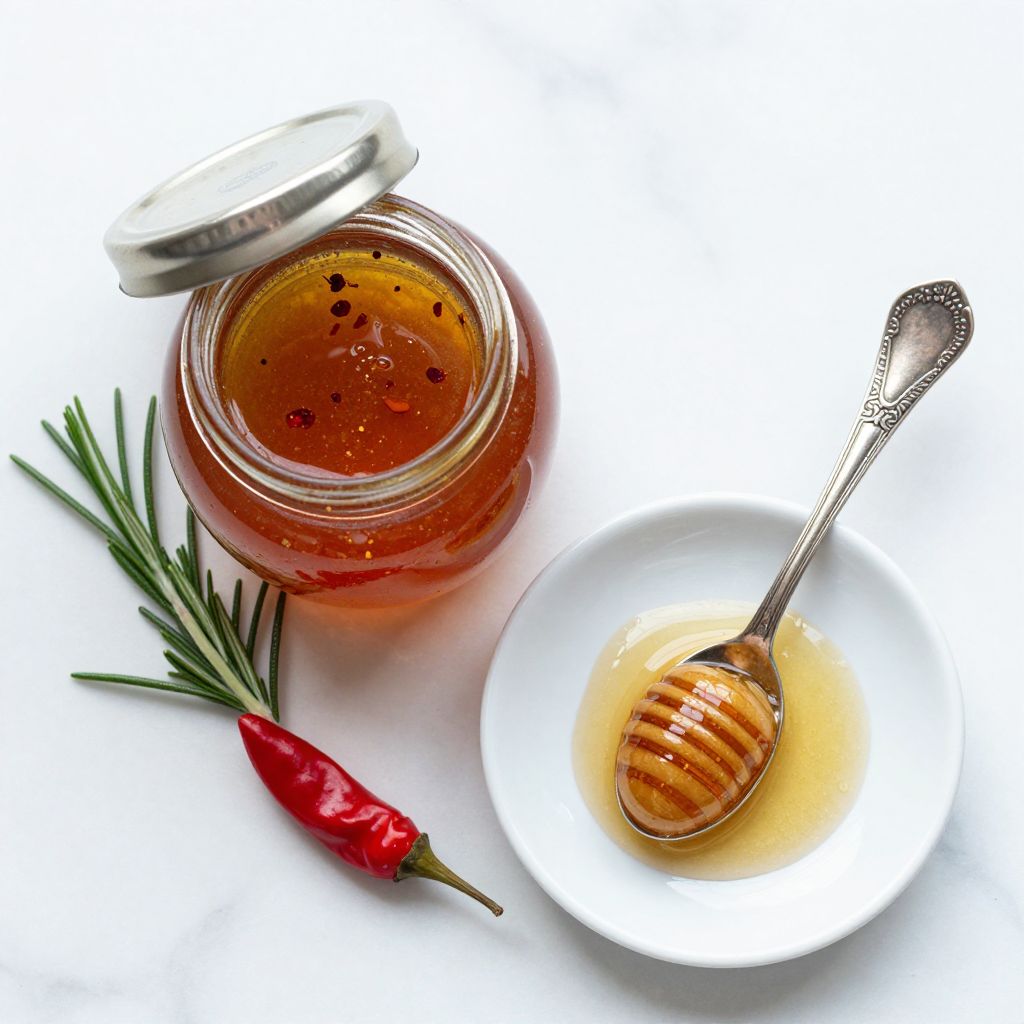
Hot honey recipe delivers that addictive sweet heat that transforms everything from fried chicken to pizza into something unforgettable. This spicy condiment takes ten minutes to make and costs a fraction of the store bought bottles. Once you have a jar in your fridge, you will wonder how you ever lived without it.
What Makes This Recipe Worth Your Time
This hot honey strikes the perfect balance between floral sweetness and slow building heat that lingers without burning. You control the spice level, the quality of honey, and the depth of flavor in ways no commercial brand can match.
- Customizable heat means you can make it mild for kids or scorching for spice lovers
- Ten minutes of active time gets you a condiment that lasts for months
- Fraction of the cost compared to premium brands like Mike’s Hot Honey
- No artificial ingredients or preservatives, just pure honey and real peppers
- Endless applications from drizzling on cheese to glazing meats to sweetening cocktails
A Little Background on This Dish
Hot honey traces its modern popularity to Brooklyn pizzerias in the early 2010s, where it became the secret weapon drizzled over pepperoni slices. The combination of honey and chili peppers, however, goes back centuries in Southern Italian cooking and across Latin American cuisines where sweet and spicy have always been natural partners.
The magic lies in how capsaicin from the peppers interacts with the sugars in honey. Heat amplifies sweetness, and sweetness tames heat, creating a flavor profile that hits multiple pleasure centers at once. This is why hot honey became a sensation rather than a passing trend.
My Experience With This Recipe
I started making hot honey after paying nine dollars for a tiny bottle that lasted exactly one pizza night. That seemed absurd for something that is basically two ingredients, so I grabbed some peppers and a jar of local honey and got to work.
My first batch was a disaster because I let it simmer too long and scorched the honey into bitter caramel. The second batch was too mild because I removed the seeds thinking I was being clever. It took me five batches to understand that hot honey rewards patience and restraint with the heat.
The night I finally nailed it, I drizzled it over some leftover fried chicken and my teenager actually put down his phone to ask what I had done differently. That small victory made all the failed batches worth it.
Before You Start: Key Things to Know
This recipe suits complete beginners, but the one challenge is temperature control. Heat honey too aggressively and you destroy its delicate flavor compounds and risk burning it.
- Difficulty level: Easy, perfect for first time cooks
- Active time vs passive time: 10 minutes active, plus 1 to 2 hours steeping
- Most important equipment: A reliable thermometer or very low heat capability on your stove
- Step requiring most attention: The warming phase, where you must keep the temperature gentle
Recipe at a Glance
- Recipe Name: Hot Honey
- Yield: About 1 cup (16 servings of 1 tablespoon each)
- Prep Time: 5 minutes
- Cook Time: 5 minutes
- Total Time: 10 minutes active, plus 1 to 2 hours steeping
- Resting Time: 1 to 2 hours minimum, overnight for best flavor
- Difficulty: Easy
- Course: Condiment
- Cuisine: American, Italian inspired
- Calories per Serving: 64
How to Source the Best Ingredients
Hot honey has only two main ingredients, so quality matters enormously. Cheap honey and stale peppers will give you a mediocre result no matter how perfect your technique.
- Honey: Look for raw, unfiltered honey with a golden amber color and a thick, slow pour. Local honey from a farmers market delivers the best floral complexity. Avoid anything labeled “honey blend” or that pours like water.
- Dried red pepper flakes: Check for vibrant red color with visible seeds. Dull, brownish flakes have lost their potency. Smell them before buying if possible; they should have a sharp, slightly fruity aroma.
- Fresh chilies (optional): Fresno or serrano peppers should feel firm with tight, glossy skin. Wrinkled or soft peppers have started to break down and will add off flavors.
- Apple cider vinegar: Choose raw, unfiltered vinegar with visible sediment, often labeled “with the mother.” This adds a rounder, more complex acidity than distilled vinegar.
Ingredients for Hot Honey
For the Hot Honey Base
- 1 cup honey, preferably raw and unfiltered
- 2 tablespoons dried red pepper flakes, crushed red pepper works well
- 1 tablespoon apple cider vinegar
- 1/4 teaspoon kosher salt
Optional Additions for Extra Depth
- 1 to 2 fresh Fresno or serrano chilies, sliced thin
- 1 small garlic clove, smashed
- 1 sprig fresh rosemary or thyme
Smart Substitutions and Swaps
- Honey: Honey provides the base sweetness and viscosity. Substitute with agave nectar for a vegan version, though you will lose some of the complex floral notes and the result will be slightly thinner.
- Dried red pepper flakes: These deliver the primary heat and visual appeal. Substitute with cayenne powder for more intense heat, but reduce the amount by half and know you will lose the textural interest of the flakes.
- Apple cider vinegar: The vinegar adds brightness and helps the honey pour smoothly. Substitute with fresh lemon juice for a cleaner citrus note, or white wine vinegar for a more neutral acidity.
- Fresh chilies: These add grassy, fruity heat notes. Substitute with a few dashes of your favorite hot sauce, adding it after the honey cools to preserve the sauce’s character.
- Garlic: Garlic adds savory depth that makes the honey more versatile. Omit it entirely for a purer honey flavor, or substitute with a pinch of garlic powder stirred in at the end.
Tools and Equipment You Will Need
Gather everything before you start because this recipe moves quickly once the honey is warm. Having your tools ready prevents scrambling while the honey heats.
- Small saucepan (heavy bottomed prevents hot spots)
- Instant read thermometer (critical for monitoring temperature without guessing)
- Wooden spoon or silicone spatula (metal conducts too much heat)
- Fine mesh strainer (if you want a smooth final product)
- Glass jar with tight fitting lid (for storage; glass does not absorb odors)
- Measuring cups and spoons
- Cutting board and knife (if using fresh chilies)
How to Make Hot Honey
Read through all the steps before starting and make sure your honey is at room temperature. Cold honey takes longer to warm and increases the risk of overheating as you wait for it to loosen up.
Step 1: Prepare Your Chilies
If using fresh chilies, slice them into thin rounds about an eighth of an inch thick, keeping the seeds intact. Use a sharp knife and a stable cutting board, working slowly to get even slices.
The seeds and membranes contain most of the capsaicin, so leaving them in ensures maximum heat transfer into the honey. Removing them creates a milder result with more fruity pepper flavor and less burn.
Your chilies are ready when you have uniform thin rounds with the seeds visible inside each slice. The thinner the slices, the more surface area contacts the honey and the faster the heat infuses.
Step 2: Measure Your Honey
Pour one cup of honey into your saucepan, using a silicone spatula to scrape out every bit from the measuring cup. Coat your measuring cup lightly with neutral oil first if you want the honey to slide out cleanly.
Precise measurement matters here because the ratio of honey to pepper flakes determines your final heat level. Too much honey dilutes the heat; too little concentrates it beyond what most palates enjoy.
The honey should pool in the bottom of the saucepan in a thick, slow moving mass. If it spreads quickly like water, your honey may be adulterated or excessively processed.
Step 3: Warm the Honey Gently
Place the saucepan over the lowest heat setting your stove allows and warm the honey slowly. Stir occasionally and watch for the honey to become noticeably more fluid, which takes about 2 to 3 minutes.
Gentle heat opens up the honey’s structure and allows it to absorb the pepper compounds efficiently. High heat destroys honey’s beneficial enzymes, damages its flavor, and can quickly scorch it into bitter caramel.
Your honey is ready when it flows easily off your spatula in a thin, continuous stream rather than a thick ribbon. An ideal temperature is around 150 degrees Fahrenheit; never exceed 180 degrees.
Step 4: Add the Pepper Flakes
Remove the saucepan from heat before adding the two tablespoons of dried red pepper flakes. Stir them in thoroughly, making sure no clumps form and every flake gets coated in honey.
Adding the flakes off heat prevents them from frying and turning bitter. The residual warmth of the honey is enough to begin extracting the capsaicin without damaging the peppers.
Watch for the pepper flakes to darken slightly and begin releasing tiny bubbles as they hydrate in the warm honey. This visual cue tells you the infusion process has started.
Step 5: Add Fresh Chilies If Using
Stir in your sliced fresh chilies, smashed garlic, and any herb sprigs you want to include. Press them gently with your spatula to submerge them fully in the honey.
Fresh chilies add a different heat profile than dried flakes: brighter, more vegetal, and with a sharper initial bite. The combination of fresh and dried creates a more complex, layered heat experience.
The chilies should be fully coated and floating freely in the honey rather than clumping together. If they stick, give them another gentle stir to separate them.
Step 6: Add the Vinegar and Salt
Pour in the tablespoon of apple cider vinegar and sprinkle in the quarter teaspoon of kosher salt. Stir gently until both are fully incorporated into the honey mixture.
Vinegar serves two purposes: it adds a subtle acidity that brightens the overall flavor and it slightly thins the honey so it drizzles more easily. Salt amplifies both the sweetness and the heat perception.
The mixture may foam slightly when you add the vinegar; this is normal and will subside with stirring. The honey should remain smooth and glossy without any separation.
Step 7: Return to Gentle Heat
Place the saucepan back over the lowest heat for 2 to 3 minutes, stirring constantly to prevent any scorching on the bottom. Keep your thermometer handy and check the temperature frequently.
This brief return to heat helps marry all the flavors together and ensures the vinegar integrates fully rather than floating on top. The constant stirring distributes the pepper oils evenly throughout.
Remove from heat when the honey just begins to show the faintest wisps of steam and registers no higher than 160 degrees. The mixture should smell intensely of honey and peppers with no burnt notes.
Step 8: Steep the Mixture
Transfer the saucepan to a trivet or folded towel and let the mixture steep at room temperature for at least one hour, or up to two hours for stronger heat. Cover loosely with a lid to keep out dust.
Steeping time is where the real flavor development happens. The capsaicin continues to migrate from the peppers into the honey even without heat, and the longer you wait, the spicier and more complex the result.
Taste the honey after one hour to check the heat level. If you want more intensity, let it steep longer. If it is already spicier than you prefer, proceed to straining immediately.
Step 9: Strain or Leave Chunky
Decide whether you want smooth hot honey or a rustic version with pepper flakes visible. For smooth, pour through a fine mesh strainer into a bowl, pressing gently on the solids to extract all the honey.
Straining gives you a clean looking condiment that drizzles elegantly and has a consistent texture. Leaving the flakes in creates a more visually interesting product with pockets of intense heat wherever the flakes land.
If straining, discard the solids once you have pressed out as much honey as possible. The remaining solids will be mostly exhausted of their heat but can be added to marinades if you hate waste.
Step 10: Transfer to Storage
Pour the finished hot honey into a clean glass jar with a tight fitting lid. Allow it to cool completely to room temperature before sealing the lid and storing.
Glass is the ideal storage material because it does not react with the honey’s acidity or absorb any flavors. Plastic can impart subtle off tastes over time and is harder to clean thoroughly.
The honey should have a beautiful amber color with a reddish tint from the peppers. It will thicken slightly as it cools but should remain pourable at room temperature.
Pro Tip: For the most complex flavor, make your hot honey the day before you plan to use it. Overnight resting allows the heat to mellow slightly while the honey absorbs deeper, more rounded pepper notes that fresh batches lack.
The Science Behind the Technique
Capsaicin, the compound that makes peppers hot, is fat soluble and dissolves readily into the sugars and small amount of natural acids present in honey. Gentle warming accelerates this extraction without destroying the capsaicin molecules or degrading the honey’s flavor compounds.
The vinegar serves a dual purpose beyond flavor. Its acidity helps break down the waxy coating on dried pepper flakes, allowing the capsaicin to release more efficiently. This is why hot honey made with vinegar tastes spicier than versions made without, even with identical pepper quantities.
Chef Note: If your hot honey seems too mild after steeping, add more pepper flakes and steep again rather than heating it further, which risks damaging the honey.
Tips for Getting It Right Every Time
- Use a thermometer until you learn to judge honey temperature by sight; even ten degrees too hot can scorch it
- Toast your pepper flakes in a dry pan for 30 seconds before adding to the honey for a deeper, smokier flavor
- Start with less heat than you think you want; you can always add more pepper flakes and steep again, but you cannot remove heat once it is infused
- Store at room temperature for the best pourable consistency; refrigeration thickens honey excessively
- Shake or stir before using if you left the pepper flakes in; they tend to settle and concentrate at the bottom
- Label your jar with the date and heat level so you can replicate or adjust your next batch
Mistakes That Will Ruin Your Dish
- Overheating the honey turns it bitter and destroys its delicate floral notes, leaving you with something that tastes like burnt sugar with a pepper afterthought
- Using old, stale pepper flakes results in dull, flat heat with no complexity; those flakes sitting in your pantry for two years will disappoint you
- Skipping the vinegar leaves the honey cloying and one dimensional; that small amount of acidity makes a surprising difference in balance
- Impatient steeping produces weak, superficial heat that fades quickly; the best hot honey needs time to develop depth
- Using processed honey from a squeeze bear gives you a bland base that no amount of pepper can rescue; quality honey is non negotiable
Make Ahead and Meal Prep Tips
Hot honey is the ideal make ahead condiment because it actually improves with age. The flavors meld and the heat integrates more smoothly over the first week of storage.
- Finished hot honey keeps at room temperature for up to 3 months or refrigerated for 6 months; make a large batch and portion into smaller jars for gifting
- Pepper flakes can be measured and stored in small containers weeks ahead; grab a container and add it to warm honey when you need a fresh batch
- Infused hot honey makes an excellent base for salad dressings and marinades; prep a double batch and use half for condiment duty and half for cooking
- Gift jars benefit from a full week of steeping before giving away; the heat stabilizes and the flavor profile becomes more consistent
What to Serve With Hot Honey
Hot honey shines as a finishing drizzle on foods with richness, salt, or mild flavors that benefit from sweet heat contrast. Think of it as the final flavor punch rather than a cooking ingredient.
- Fried chicken: The crispy, salty exterior creates the perfect foil for the sweet heat, making each bite addictively balanced
- Pepperoni pizza: Drizzle over a fresh slice and experience why Brooklyn pizzerias started this trend in the first place
- Soft cheeses: Burrata, fresh mozzarella, and ricotta become restaurant worthy appetizers with a spoonful of hot honey
- Cornbread: The subtle sweetness of cornbread amplifies when hit with spicy honey; try this with a pat of butter too
- Vanilla ice cream: Sounds strange but the combination of cold, creamy, sweet, and spicy is genuinely revelatory
Drink Pairings
A crisp, off dry Riesling balances the honey’s sweetness while its acidity cuts through the heat, refreshing your palate between bites. The slight sweetness in the wine echoes the honey without competing with it.
- Wine: Sparkling Prosecco or Lambrusco, where the bubbles and slight sweetness complement the honey’s floral notes
- Beer: A Belgian witbier or hefeweizen, whose wheat character and citrus notes play beautifully with the spicy sweetness
- Non alcoholic: Sparkling water with a squeeze of lemon, keeping your palate clean between bites of hot honey glazed foods
- Hot drink: Black tea with a spoonful of hot honey stirred in creates a warming, gently spiced beverage perfect for cold mornings
Flavour Variations Worth Trying
- Smoky chipotle version: Replace half the red pepper flakes with ground chipotle powder for a deep, smoky heat. The result tastes almost barbecue adjacent and works brilliantly on grilled meats.
- Citrus ginger: Add a tablespoon of fresh ginger slices and a strip of orange zest during steeping. You get a brighter, more aromatic honey that excels in Asian inspired dishes and cocktails.
- Garlic rosemary: Double the garlic and add two rosemary sprigs during steeping. This savory leaning version shines brushed on roasted vegetables and crusty bread.
- Ghost pepper extreme: Add a single dried ghost pepper, crumbled, for serious heat seekers. This version is not for casual use; a few drops will set your mouth ablaze in the best way.
- Bourbon barrel: Stir in a tablespoon of bourbon after the honey cools for a boozy, complex variation. The alcohol cooks off if you use it for glazing, but raw applications retain a pleasant warmth.
How to Adapt This Recipe for Your Diet
- Gluten free: This recipe is naturally gluten free with no modifications needed; just verify your vinegar brand does not process on shared equipment
- Dairy free: Hot honey contains no dairy whatsoever; enjoy it freely on any dairy free application
- Vegan: Substitute agave nectar or maple syrup for the honey; the result will be thinner and less complex but still delivers the sweet heat profile
- Low carb and keto: Replace honey with a sugar free monk fruit sweetener syrup; the texture will differ and you lose the floral notes but retain the heat element
- High protein: Hot honey itself is not a protein source, but use it to glaze high protein foods like chicken breast, salmon, or tofu to add flavor without significant macros
How to Store and Reheat
In the Refrigerator
Store hot honey in a sealed glass jar in the refrigerator for up to 6 months. The cold will thicken it considerably, so bring it to room temperature before using or warm the jar briefly in hot water.
- Keep the jar away from strong smelling foods as honey can absorb odors even through the lid seal
- If crystallization occurs, gently warm the jar in a bowl of hot water until smooth again
In the Freezer
Freezing hot honey is unnecessary given its long shelf life, but it will not harm the product. Honey does not freeze solid due to its low water content and high sugar concentration.
- If you freeze for any reason, thaw overnight in the refrigerator for best texture
- Avoid repeated freeze thaw cycles which can cause moisture issues and potential fermentation
Reheating
Place the jar in a bowl of hot tap water for 5 to 10 minutes to restore pourable consistency. Avoid direct heat which can damage the honey.
- Best method: Warm water bath preserves flavor and gently loosens the honey without any risk of scorching
- Stovetop method: Transfer to a saucepan over lowest heat and stir constantly; remove immediately once pourable
- Microwave method: Use with extreme caution in 10 second bursts only; honey can superheat and burn instantly in microwaves
Cost Breakdown
A premium bottle of hot honey costs eight to twelve dollars for eight ounces at most grocery stores. Making your own costs roughly a third of that price and yields better flavor with customizable heat.
| Ingredient | Estimated Cost |
|---|---|
| Honey (1 cup) | $4.00 |
| Dried red pepper flakes (2 tablespoons) | $0.30 |
| Apple cider vinegar (1 tablespoon) | $0.10 |
| Kosher salt (1/4 teaspoon) | $0.02 |
| Fresh chilies, optional (2 peppers) | $0.40 |
| Total Per Serving (16 servings) | $0.30 |
Nutrition Information
| Nutrient | Amount |
|---|---|
| Calories | 64 |
| Total Fat | 0g |
| Saturated Fat | 0g |
| Trans Fat | 0g |
| Cholesterol | 0mg |
| Sodium | 18mg |
| Total Carbohydrates | 17g |
| Dietary Fiber | 0g |
| Total Sugars | 17g |
| Added Sugars | 0g |
| Protein | 0g |
| Vitamin D | 0mcg |
| Calcium | 1mg |
| Iron | 0.1mg |
| Potassium | 11mg |
Nutritional values are estimates based on standard ingredient data and will vary depending on specific brands and exact measurements used.
Frequently Asked Questions
Can I use a different type of pepper instead of red pepper flakes?
Yes, you can use cayenne, gochugaru, Aleppo pepper, or any dried chili you prefer. Adjust the quantity based on the pepper’s heat level, starting with less for very hot varieties.
Can I make hot honey ahead of time for a party?
Absolutely, and it actually tastes better when made 2 to 3 days in advance. The flavors meld and the heat becomes more integrated with resting time.
How long does homemade hot honey last?
Stored properly in a sealed glass jar, hot honey keeps for 3 months at room temperature and up to 6 months refrigerated. The high sugar content naturally preserves it.
Why did my hot honey turn grainy or crystallized?
Crystallization is natural and does not mean the honey has spoiled. Gently warm the jar in hot water and stir until smooth; it will return to its original texture.
Can I double or triple this recipe?
Yes, scale up all ingredients proportionally and use a larger saucepan. Keep the heat gentle and stir frequently since larger batches take slightly longer to warm evenly.
Should I strain out the pepper flakes or leave them in?
This is personal preference. Straining gives you a cleaner look for drizzling, while leaving them in creates visual interest and pockets of extra heat.
Can I use hot honey in baking or cooking?
Yes, but high heat will diminish the nuanced honey flavor. Add it at the end of cooking as a glaze or finishing drizzle for best results.
My Final Word
This hot honey recipe delivers that perfect balance of floral sweetness and lingering heat that makes ordinary foods extraordinary. A drizzle transforms fried chicken, pizza, cheese plates, and even desserts into something memorable.
I have made dozens of batches refining this recipe, and every step is here because it makes a difference. Trust the process, keep the heat gentle, and give it time to steep.
Once you try your homemade version, I think you will never go back to the store bought stuff. Make a batch this weekend and let me know how it turns out in the comments or tag us on social media.
Hot Honey
This hot honey recipe delivers the perfect balance of floral sweetness and slow building heat that transforms everything from fried chicken to pizza. Made in just 10 minutes with simple ingredients, this customizable spicy condiment costs a fraction of store bought bottles and keeps for months.
- Small heavy-bottomed saucepan
- Instant-read thermometer
- Wooden spoon or silicone spatula
- Fine mesh strainer
- Glass jar with tight-fitting lid
- Measuring cups and spoons
- Cutting board and knife
Hot Honey Base
- 1 cup honey (preferably raw and unfiltered)
- 2 tablespoons dried red pepper flakes
- 1 tablespoon apple cider vinegar
- 1/4 teaspoon kosher salt
Optional Additions
- 1 to 2 fresh Fresno or serrano chilies (sliced thin)
- 1 small garlic clove (smashed)
- 1 sprig fresh rosemary or thyme
- If using fresh chilies, slice them into thin rounds about an eighth of an inch thick, keeping the seeds intact for maximum heat.
- Pour 1 cup of honey into a small heavy-bottomed saucepan, using a silicone spatula to scrape out every bit from the measuring cup.
- Place the saucepan over the lowest heat setting and warm the honey slowly for 2 to 3 minutes, stirring occasionally until it becomes noticeably more fluid. Do not exceed 150°F (65°C).
- Remove the saucepan from heat and add the 2 tablespoons of dried red pepper flakes. Stir thoroughly to coat every flake in honey.
- If using, stir in the sliced fresh chilies, smashed garlic, and herb sprigs, pressing gently to submerge them in the honey.
- Add the 1 tablespoon of apple cider vinegar and 1/4 teaspoon of kosher salt. Stir gently until fully incorporated.
- Return the saucepan to the lowest heat for 2 to 3 minutes, stirring constantly. Remove from heat when the honey shows faint wisps of steam and registers no higher than 160°F (71°C).
- Transfer to a trivet and let the mixture steep at room temperature for 1 to 2 hours, or overnight for best flavor. Cover loosely with a lid.
- For smooth hot honey, strain through a fine mesh strainer into a bowl, pressing gently on the solids. Alternatively, leave the pepper flakes in for a rustic version.
- Pour the finished hot honey into a clean glass jar. Allow to cool completely before sealing and storing at room temperature for up to 3 months.
For the most complex flavor, make your hot honey the day before you plan to use it. Overnight resting allows the heat to mellow slightly while the honey absorbs deeper, more rounded pepper notes. Store at room temperature for best pourable consistency. Shake or stir before using if you left the pepper flakes in, as they tend to settle at the bottom.